Many practices in madarsa systems are often judged without understanding their context. What may appear as a ritual is, in reality a practical response to socio economic challenges faced by underprivileged communities. This article highlights how madarsas in the Indian subcontinent evolved as community supported institutions unlike state funded systems in many Islamic countries. It explains that practices like Qur’an khwani are not fixed religious obligations but support mechanisms that developed over time to sustain students and institutions. A deeper balanced understanding is essential to avoid confusion and division and to move towards thoughtful reform with unity and wisdom.
In today’s fast moving world of social media debates and instant opinions, many practices within the Muslim community such as Qur’an recitation gatherings (often called Qur’an khwani) are quickly judged. They are either labelled as bid’ah (innovation) or dismissed as unnecessary. But such judgments often miss a very important point, not everything we see today began as a religious ritual. Many practices emerged as practical responses to real-life challenges. To truly understand, we must look beyond labels and into context.
The Ground Reality: Islamic Education in the Subcontinent
In countries like India, Pakistan and Bangladesh a large section of the Muslim population has historically faced economic hardship. Yet the need for religious continuity has always remained strong, mosques need imams, communities need scholars and the Qur’an must be preserved through “Huffaz”. Unlike many modern education systems, Islamic education has rarely received strong institutional or government support especially after the colonial period. In this gap the community stepped forward. This gave rise to the madarsa system, a decentralized community support model that became the backbone of religious education.
Madarsas have played a crucial role by providing free education to children from underprivileged families ensuring the availability of imams and Qur’an memorizers and running almost entirely on zakat, sadaqah, and community donations. This system was not just about education, it was about survival and continuity of faith.
How practices evolved with need
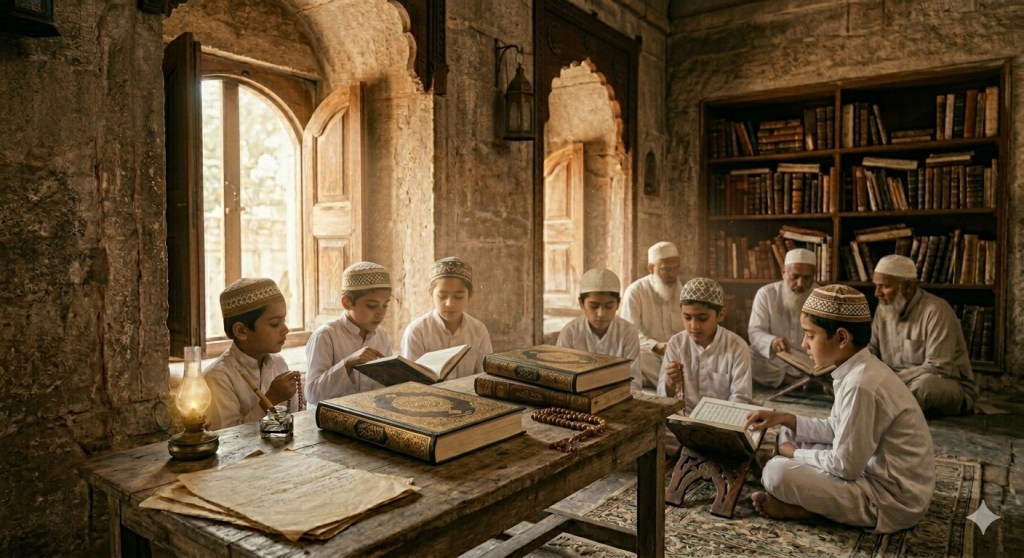
As madarsas expanded, so did their challenges, especially financial sustainability. In response communities developed simple yet meaningful support systems. One such practice involves groups of madarsa students visiting homes on various occasions like after a death, at the start of a new venture, house inaugurations, childbirth, chhathi and other important moments, to recite the Qur’an.
This recitation is often done for isaal e sawab (conveying reward to the deceased), reflecting care and hope for divine mercy. At the same time, it is also seen as an auspicious beginning, a way of seeking blessings and good for worldly matters. In return, families may offer food or modest financial support, helping students who often have very limited means. Over time Qur’an khwani has come to represent a shared space of faith, remembrance and community bonding. However, it is important to recognize that while reciting the Qur’an is a virtuous act, organizing such gatherings is not a fixed religious obligation. Rather it is a socially evolved and devotional practice shaped by context.
At first glance, this may seem like a ritual. But in reality, it functioned as a micro support system helping madarsa students who had little or no financial backing. It is important to understand, this practice was not created to introduce something new in religion but to support those dedicated to preserving it.
Understanding the deeper context
A more balanced and constructive approach Instead of reacting with rejection or blind acceptance a more thoughtful path is needed-
Where misunderstanding begins is exactly where context is ignored. Confusion arises when a context based social practice is treated as a fixed religious obligation without understanding how Islamic institutions historically evolved. Islam as a complete way of life clearly distinguishes between core acts of worship which are fixed and divinely defined and social or institutional arrangements which are human led, flexible, and evolve with time and context. When this distinction is ignored, unnecessary debates and divisions arise within the community.
Historically during the time of the Prophet (PBUH), learning was direct, simple and deeply personal. The companions themselves became ‘Hafiz’ and scholars through close engagement and learning. But as Islamic society expanded after that period a more organized system of education became necessary. During the time of the “Khulafa” and later Islamic empires rulers actively supported institutions of learning. Madrasas, libraries and centers of knowledge were established with strong state backing. The goal was not only to preserve knowledge but to expand it with quality and build a well informed society. These were part of a larger vision often funded and encouraged directly by rulers.
In contrast, the madarsa system in the Indian subcontinent developed under very different conditions. Here madrasas were not supported by the state. Instead they were built through the efforts of ulema and local communities mainly to preserve religious knowledge and to ensure that namaz, mosques could function properly. They played an important role in preparing individuals who could lead daily prayers guide the community, and become “Hafiz e Qur’an” with proper understanding of Islamic teachings.
Importantly these madrasas mostly served the poorest sections of society especially children who had very limited means including orphans. Without any structured government funding they survived through “zakat, khairat, and sadaqah”. Their survival itself is a powerful example of community strength and faith based support.
Within this reality, practices like Qur’an khwani evolved not as fixed religious obligations but as practical and compassionate responses to economic challenges. They helped ensure that students had food, basic support and dignity. This leads to an important insight, madarsa systems in South Asia are products of socio-economic realities while in many Islamic countries they developed under state support. Comparing the two without understanding this difference often leads to incomplete and misleading conclusions.
- Understand the intention – These systems were created to serve real needs not to distort religion.
- Separate principle from practice – Reciting the Qur’an is an act of worship; organizing support around it is a human effort.
- Support meaningful reform – Strengthen madrasas through skill based and modern education, improved funding models, and wider opportunities for students so they can grow not just as workers but as independent and capable entrepreneurs.
Moving from Judgment to Understanding
It is easy to criticize from a distance. It is far more honest and responsible to understand the circumstances behind a practice. The madarsa system and its associated practices should not be seen only through the narrow lens of “bid’ah” or rigid conformity. They are in many ways, organic responses to real challenges faced by a community striving to preserve its faith. What we need today is not division but clarity, compassion and constructive thinking. Only then can we protect both the essence of the faith and the dignity of those who serve it.
Author: Arif M. Akhtar | Policy & Social Development Practitioner
……………
 THE INKWELL
Leave a comment